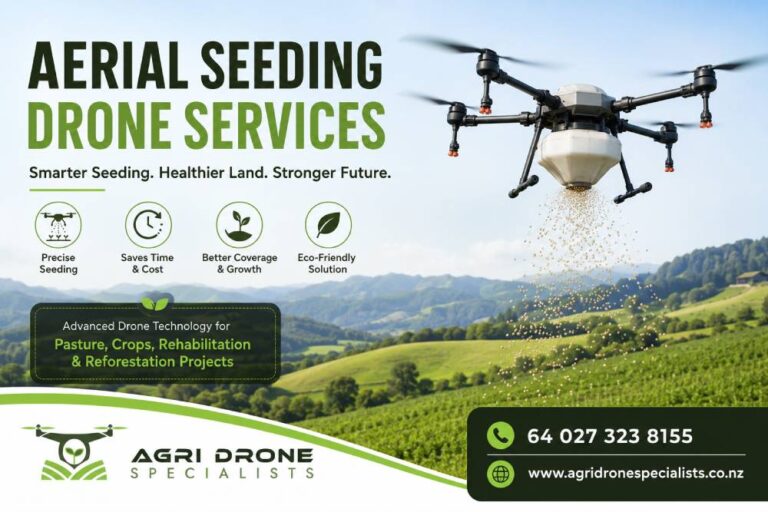
Land restoration, reforestation, and pasture development have always been time-sensitive and labour-intensive processes. Traditional seeding methods often struggle to keep up with modern demands, especially when dealing with uneven terrain, large land areas, or limited accessibility. This is where Aerial Seeding Drone Services are reshaping the way landowners approach seeding and regeneration.
Instead of relying on manual labour or ground-based machinery, drone technology offers a streamlined solution that combines speed, precision, and adaptability. By taking seeding operations to the air, this method provides a practical way to achieve consistent results across a wide range of landscapes. Its cost effective and fast making it a viable option in today farming.
Why Traditional Seeding Methods Fall Behind
Conventional seeding approaches typically involve tractors, spreaders, or manual broadcasting. While effective in certain conditions, these methods often face limitations in hilly, muddy, or densely vegetated areas. Accessibility becomes a major concern, and uneven distribution can lead to poor germination rates.
Another common challenge is time. Large-scale seeding projects require significant labour and coordination, which can delay critical planting windows. When timing is off, the success of seed establishment can be compromised.
This leads to an important consideration—is there a faster and more reliable way to ensure uniform seed coverage?
How Aerial Seeding Drone Services Work
Aerial Seeding Drone Services utilise advanced drones equipped with precision spreading systems and GPS-guided navigation. These drones are programmed to follow specific flight paths, ensuring seeds are distributed evenly across targeted areas.
The technology allows operators to adjust seeding rates based on terrain, soil conditions, and project goals. Whether it’s reforesting a hillside, restoring pasture, or covering hard-to-reach zones, drones provide a level of control that traditional methods often lack.
By operating from above, drones eliminate the need for heavy machinery, reducing ground disturbance and preserving soil integrity.
Key Advantages of Drone-Based Seeding
One of the most notable benefits of drone seeding is efficiency. Large areas can be covered in a fraction of the time compared to manual or mechanical methods. This makes it easier to complete projects within optimal planting periods.
Because the drones have large capacity, it does it in quick time making it a cost effective solution to other methods.
Precision is another major advantage. Drones ensure consistent seed distribution, which improves germination rates and leads to more uniform growth. This targeted approach also reduces seed wastage, helping landowners make better use of resources.
Accessibility plays a crucial role as well. Steep slopes, wetlands, and remote areas are no longer barriers.
Drones can easily navigate these environments, ensuring that no section of land is left untreated.
Additionally, reduced reliance on heavy equipment minimises soil compaction, which supports healthier root development and long-term land productivity.
Supporting Environmental and Sustainable Goals
Sustainability is a growing priority in land management, and Aerial Seeding Drone Services align well with environmentally responsible practices. By optimising seed placement and reducing unnecessary disturbance, drones help protect natural ecosystems.
This method is particularly valuable for reforestation and erosion control projects, where precise seeding can stabilise soil and encourage vegetation growth. Over time, this contributes to improved biodiversity and stronger land resilience.
It also raises a key question for landowners—how can modern technology support both productivity and environmental responsibility at the same time?
The Future of Seeding and Land Development
As technology continues to advance, drone-based solutions are becoming a key part of modern land management strategies. Aerial Seeding Drone Services offer a forward-thinking approach that combines efficiency, precision, and sustainability.
Rather than replacing traditional methods entirely, drones enhance and optimise the process—allowing landowners to achieve better results with fewer limitations. As demand for smarter agricultural and environmental solutions grows, aerial seeding is set to play an increasingly important role.