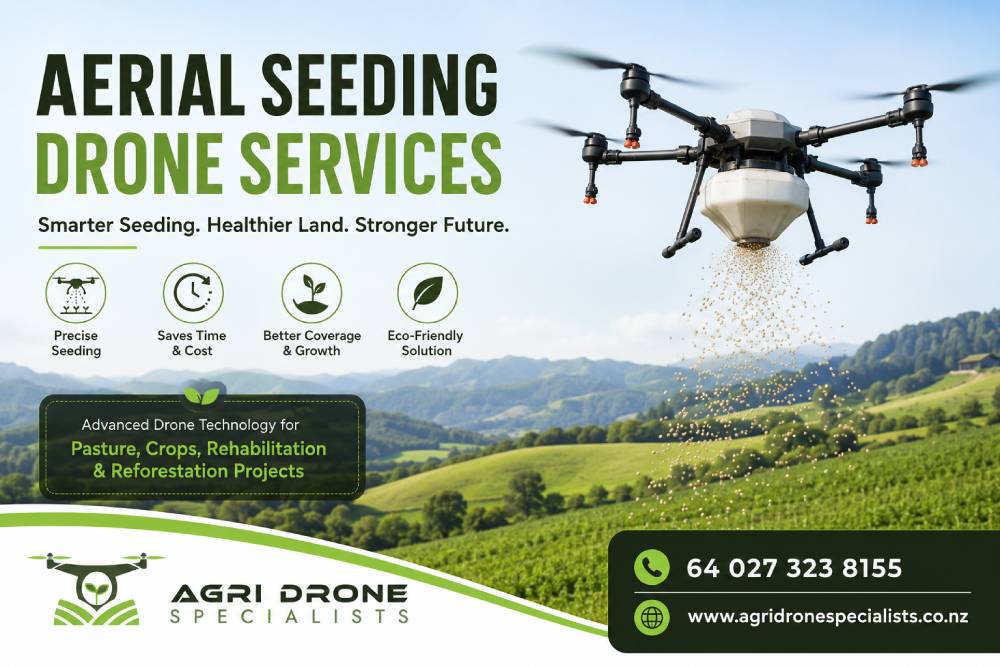

Aerial Seeding Drone Services: A New Era of Precision Agriculture
As agriculture continues to embrace innovative technologies, aerial seeding has emerged as one of the most effective methods for establishing vegetation across challenging landscapes. Traditional seeding methods often require significant labour, machinery, and time, especially in areas with steep slopes, remote access, or environmentally sensitive terrain. This is where Aerial Seeding Drone Services are making a significant impact.
By combining advanced drone technology with precision agriculture practices, aerial seeding offers landowners, farmers, forestry managers, and environmental restoration projects a smarter way to distribute seed accurately and efficiently.
What Are Aerial Seeding Drone Services?
Aerial seeding drone services involve the use of specially designed agricultural drones equipped with seed-spreading systems. These drones fly predetermined routes using GPS technology and distribute seeds evenly across targeted areas.
Unlike conventional ground-based seeding methods, drones can access difficult locations without disturbing the soil or requiring heavy machinery. This capability makes aerial seeding particularly useful for land restoration, pasture renewal, erosion control, and forestry applications.
The technology enables operators to accurately control seed rates, coverage areas, and flight paths, ensuring consistent and efficient seed distribution.
Why Is Aerial Seeding Becoming More Popular?
The growing popularity of aerial seeding is largely driven by the increasing demand for sustainable and efficient land management practices. Property owners are looking for solutions that reduce costs while improving productivity and environmental outcomes.
Several factors contribute to the rise of drone-based seeding:
• Improved operational efficiency
• Reduced labour requirements
• Access to difficult terrain
• Greater precision and consistency
• Lower environmental impact
• Faster project completion
These benefits have positioned aerial seeding drones as a valuable tool in modern agriculture and ecological restoration projects.
Key Applications of Aerial Seeding Drones
Pasture Establishment
Farmers often use aerial seeding to establish or rejuvenate pasture in areas where conventional equipment may struggle to operate. Steep hillsides and remote grazing land can be seeded efficiently without causing soil compaction.
Forestry and Reforestation
Drone seeding is increasingly being used in forestry projects to establish vegetation, regenerate harvested areas, and support reforestation efforts. The ability to reach remote locations makes drones particularly effective for large-scale forestry operations.
Land Rehabilitation
Areas affected by erosion, natural disasters, mining activities, or land degradation can benefit from rapid vegetation establishment through aerial seeding. Quick coverage helps stabilise soil and promotes ecological recovery.
Environmental Conservation
Conservation organisations are exploring drone technology to support habitat restoration, native planting initiatives, and biodiversity enhancement projects.
Advantages of Aerial Seeding Drone Services
Precision Coverage
Modern drones utilise advanced GPS systems to ensure accurate seed placement and consistent coverage. This precision helps improve germination potential while reducing seed waste.
Access to Challenging Terrain
Steep slopes, rugged landscapes, wetlands, and remote areas that are difficult for traditional machinery can be reached with ease by aerial drones.
Reduced Soil Compaction
Heavy machinery can compact soil and negatively affect plant growth. Drone seeding eliminates this issue because the equipment never touches the ground.
Faster Deployment
Large areas can often be seeded more quickly than with conventional methods, allowing projects to progress efficiently and within optimal planting windows.
Improved Safety
Drone operations reduce the need for workers to access hazardous terrain, helping minimise operational risks.
The Future of Drone-Based Seeding
The future of aerial seeding looks increasingly promising as drone technology continues to evolve. Improvements in payload capacity, flight efficiency, mapping capabilities, and artificial intelligence are expected to further enhance operational effectiveness.
As environmental sustainability becomes a greater priority across industries, aerial seeding is likely to play a growing role in agriculture, forestry, conservation, and land restoration projects worldwide.
Many experts believe drone technology will become a standard component of integrated land management strategies due to its ability to deliver both economic and environmental benefits.
Final Thoughts
The demand for efficient, sustainable, and precise land management solutions continues to grow. Aerial Seeding Drone Services represent a major advancement in how vegetation is established across agricultural, forestry, and restoration landscapes.
By offering accurate seed distribution, access to challenging terrain, reduced environmental impact, and faster project completion, drone seeding is helping reshape the future of modern land management. As technology continues to advance, aerial seeding is expected to become an increasingly important tool for supporting productive and environmentally responsible land use practices.


